
Create the destination issue
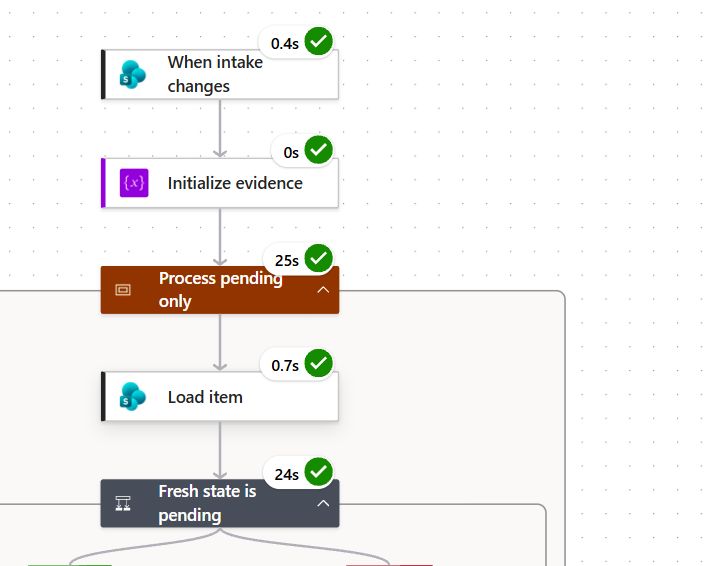
The genuine October 2 execution contains a successful ticket-creation action.
Evidence boundary: One historical qualifying path, not all request types or message channels.

Anonymized founder implementation
A Power Automate workflow repair connecting message intake, a reviewable queue and controlled ticket creation with read-back verification.
Deer Lake & Metrotown · Burnaby
The problem
The decision contract and the worker’s creation condition disagreed. A qualifying request could reach the worker while still being prevented from entering the ticket-creation branch.
The implementation
Used a private SharePoint queue between message intake and processing, with an explicit state for pending work and processing outcomes.
Aligned the creation gate with the decision response so qualifying evidence could reach the intended branch.
Preserved duplicate checks, review fallback and create-attempt tracking. Uncertain evidence continued to have a controlled review path.
Read the created issue back, checked its returned fields and persisted the completed queue outcome. A successful wrapper alone was not the acceptance check.
Inside the implementation
The worker expected evidence that the classifier had been instructed not to supply. Repairing that mismatch restored the qualifying branch while retaining its guards.
A creation condition required a decision field that the classifier’s response contract excluded. An actionable request could be classified correctly but still fail the worker’s creation gate. The repair aligned those two contracts.
A private SharePoint queue separates intake from processing and records the current outcome. Pending-state checks and create-attempt evidence make the handoff inspectable. The queue is not proof that all incoming requests have been handled.
Duplicate evidence, review fallback and create-attempt recording were retained. An uncertain creation result has a hold/review path so a missing acknowledgement is not treated as permission for a blind repeat.
The recorded path creates the issue, verifies its key, reads the destination issue back and verifies required fields before completion. A successful wrapper status alone cannot establish that the intended destination record is correct.
Recorded acceptance checks
Historical execution: October 2, 2026. Creation, key, read-back and field action statuses were independently re-inspected read-only on October 6.
The genuine October 2 execution contains a successful ticket-creation action.
Evidence boundary: One historical qualifying path, not all request types or message channels.
Key verification and destination issue read-back both returned Succeeded when the action history was re-inspected October 6.
Evidence boundary: Read-only action metadata for the same October 2 run; no new run was submitted.
The same historical execution’s required-field verification action returned Succeeded in the October 6 inspection.
Evidence boundary: Action success, with payloads and issue identifiers kept private.
Saved October 2 evidence records the matching completed queue state following creation and verification.
Evidence boundary: Historical saved evidence; the October 6 check did not re-audit every queue record.
Reader walkthrough
A reliable message-to-ticket process makes the decision, safety gate and proof of creation visible as separate steps.
These are scoping prompts for a similar project, not a diagnosis of your systems or a promised result.
Specify the evidence a request must contain before it can create a ticket. Keep uncertain or incomplete items on a named review path.
Check that the decision response supplies every required field the worker uses to authorize creation; test both the qualifying and review branches.
Record an attempt before acting, preserve duplicate checks, and make a failed or ambiguous step recoverable without silently marking the request complete.
After creation, compare the returned key and required fields with the queued request. Complete the queue item only after that check succeeds.
Scope and evidence
This verifies the recorded creation path. It does not prove every request type, historical reconciliation, continuous uptime or a fully autonomous support service. A real message exceeding 20,000 characters still requires its separate end-to-end check. No time saving or ROI was measured.
Founder implementation experience; no consultancy-client relationship, testimonial, savings or revenue outcome is implied.
Apply the lesson
For business automation, define the evidence needed to act, a safe review route and a check of the resulting record. A green flow status is useful when the intended actions also completed.

A practical place to start
Burnaby Mountain viewpoint